The most common mistakes when buying used vehicles and how to avoid them
🚗 Introduction
Buying a used car can be an excellent decision… or a nightmare if you don’t know what you’re doing. From hidden problems to incomplete paperwork, there are many mistakes that can cost you time, money or even put your safety at risk.
In this article, we review the most common mistakes when buying a used vehicle and how to avoid them. Whether you are a buyer or a dealership, this guide will help you carry out safer, more transparent and more efficient transactions.
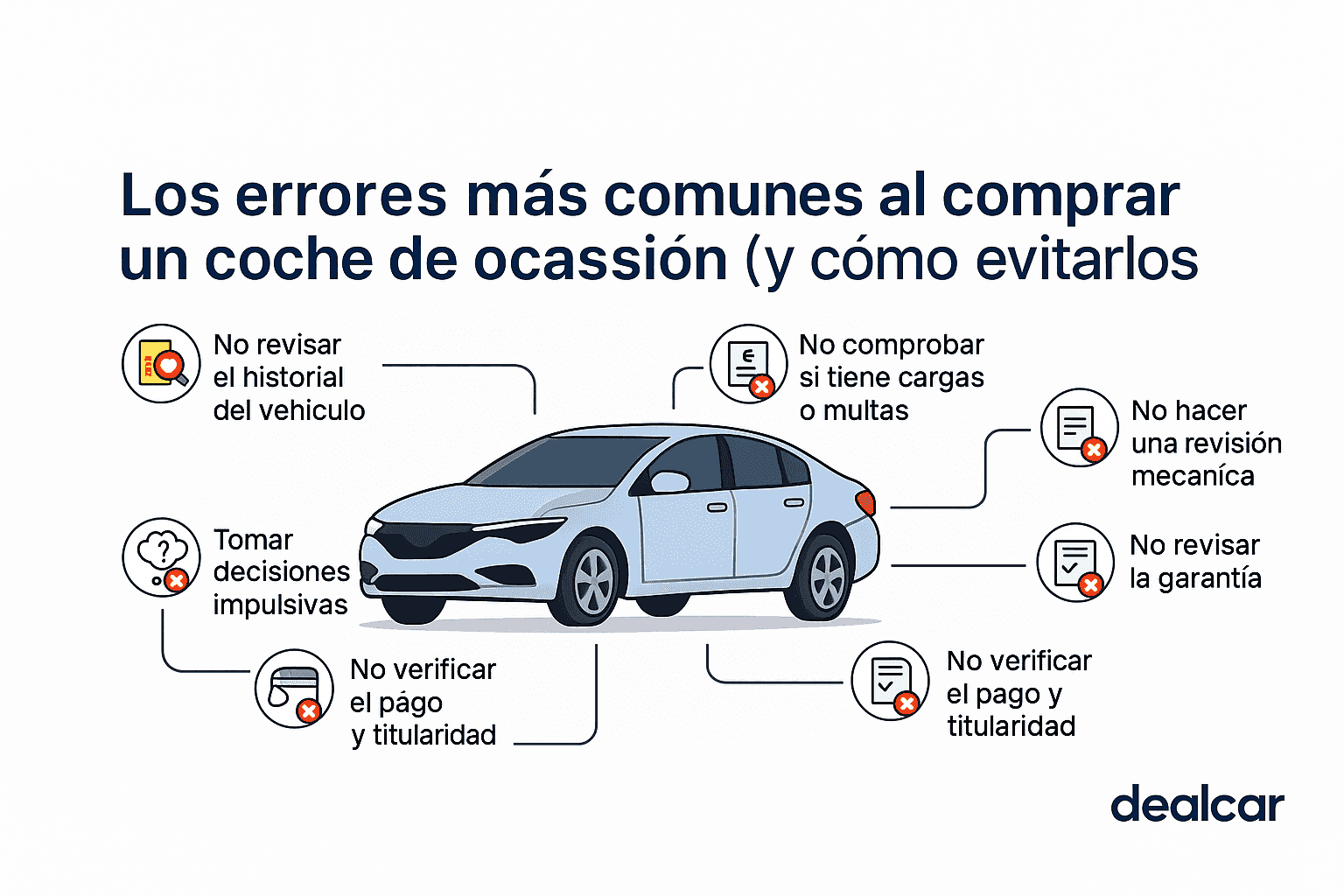
🔍 1. Not checking the vehicle history
One of the most common mistakes is to rely solely on what the seller says.
The history can reveal:
Actual mileage.
Whether it has had accidents or structural damage.
Outstanding charges or liens.
Number of previous owners.
💡 How to avoid it:
Request the DGT report or use professional platforms to check the vehicle history. At Dealcar, we integrate this information directly into the car listing for greater transparency.
📋 2. Not signing a detailed purchase agreement
Many private sales are closed with a simple “verbal agreement”, which offers no legal guarantee whatsoever.
💡 How to avoid it:
The contract should include:
Full details of buyer and seller.
Technical information about the vehicle.
Price and method of payment.
Liability statement.
Dealerships using Dealcar can generate these contracts automatically and keep them digitally archived.
🧾 3. Not checking whether the vehicle has outstanding charges or fines
Buying a car with charges (leasing, retention of title, liens) can cause you many problems. The same applies if it has unpaid fines.
💡 How to avoid it:
Check the traffic report or verify the administrative status on official platforms.
At Dealcar we automatically alert you if a vehicle has active legal or financial issues.
🧪 4. Not carrying out a mechanical inspection before buying
Although the car may look fine on the outside, it may have problems in the engine, brakes, transmission or electronics that are not visible at first glance.
💡 How to avoid it:
Take a test drive and request a technical inspection by an independent garage.
Many professional dealerships already offer checked and certified vehicles, and in Dealcar you can mark these attributes to give the buyer more confidence.
⏱️ 5. Making impulsive decisions or not comparing options
Buying a car without having compared similar models, prices or conditions can make you lose money or lead you to make the wrong choice.
💡 How to avoid it:
Use online tools to compare vehicles. At Dealcar, we offer internal search tools with advanced filters that help you find the best option quickly.
💳 6. Not verifying the payment process and change of ownership
Not being clear about how payment is made or whether the change of ownership has been properly processed can lead to later legal disputes.
💡 How to avoid it:
Make payments through secure methods and require proof of payment.
In private sales, make sure the change of ownership is processed with the DGT.
Dealerships operating with Dealcar can automate these steps through Dealcar Pay, integrating payments, contract signing and documentation from a single platform.
🛑 7. Not checking the warranty (if there is one)
Many buyers think they have no right to make a claim. But in dealership transactions there is a mandatory legal warranty.
💡 How to avoid it:
Ask about the warranty offered and exactly what it covers.
With Dealcar, you can document and customise the warranty associated with each car sold, strengthening trust with the customer.
🧭 Conclusion: Buying safely is possible
Avoiding these common mistakes can make the difference between a good purchase and a disaster. Whether you are a buyer or a dealership, the key is to stay informed, verify and use digital tools that make a safer, more professional process easier.
✅ If you are a dealership, Dealcar helps you digitise the entire operation: from the initial lead, documentation and follow-up, right through to the sale and after-sales.
Solicita una demo gratuita de Dealcar
The most common mistakes when buying used vehicles and how to avoid them
🚗 Introduction
Buying a used car can be an excellent decision… or a nightmare if you don’t know what you’re doing. From hidden problems to incomplete paperwork, there are many mistakes that can cost you time, money or even put your safety at risk.
In this article, we review the most common mistakes when buying a used vehicle and how to avoid them. Whether you are a buyer or a dealership, this guide will help you carry out safer, more transparent and more efficient transactions.
🔍 1. Not checking the vehicle history
One of the most common mistakes is to rely solely on what the seller says.
The history can reveal:
Actual mileage.
Whether it has had accidents or structural damage.
Outstanding charges or liens.
Number of previous owners.
💡 How to avoid it:
Request the DGT report or use professional platforms to check the vehicle history. At Dealcar, we integrate this information directly into the car listing for greater transparency.
📋 2. Not signing a detailed purchase agreement
Many private sales are closed with a simple “verbal agreement”, which offers no legal guarantee whatsoever.
💡 How to avoid it:
The contract should include:
Full details of buyer and seller.
Technical information about the vehicle.
Price and method of payment.
Liability statement.
Dealerships using Dealcar can generate these contracts automatically and keep them digitally archived.
🧾 3. Not checking whether the vehicle has outstanding charges or fines
Buying a car with charges (leasing, retention of title, liens) can cause you many problems. The same applies if it has unpaid fines.
💡 How to avoid it:
Check the traffic report or verify the administrative status on official platforms.
At Dealcar we automatically alert you if a vehicle has active legal or financial issues.
🧪 4. Not carrying out a mechanical inspection before buying
Although the car may look fine on the outside, it may have problems in the engine, brakes, transmission or electronics that are not visible at first glance.
💡 How to avoid it:
Take a test drive and request a technical inspection by an independent garage.
Many professional dealerships already offer checked and certified vehicles, and in Dealcar you can mark these attributes to give the buyer more confidence.
⏱️ 5. Making impulsive decisions or not comparing options
Buying a car without having compared similar models, prices or conditions can make you lose money or lead you to make the wrong choice.
💡 How to avoid it:
Use online tools to compare vehicles. At Dealcar, we offer internal search tools with advanced filters that help you find the best option quickly.
💳 6. Not verifying the payment process and change of ownership
Not being clear about how payment is made or whether the change of ownership has been properly processed can lead to later legal disputes.
💡 How to avoid it:
Make payments through secure methods and require proof of payment.
In private sales, make sure the change of ownership is processed with the DGT.
Dealerships operating with Dealcar can automate these steps through Dealcar Pay, integrating payments, contract signing and documentation from a single platform.
🛑 7. Not checking the warranty (if there is one)
Many buyers think they have no right to make a claim. But in dealership transactions there is a mandatory legal warranty.
💡 How to avoid it:
Ask about the warranty offered and exactly what it covers.
With Dealcar, you can document and customise the warranty associated with each car sold, strengthening trust with the customer.
🧭 Conclusion: Buying safely is possible
Avoiding these common mistakes can make the difference between a good purchase and a disaster. Whether you are a buyer or a dealership, the key is to stay informed, verify and use digital tools that make a safer, more professional process easier.
✅ If you are a dealership, Dealcar helps you digitise the entire operation: from the initial lead, documentation and follow-up, right through to the sale and after-sales.
Solicita una demo gratuita de Dealcar
The most common mistakes when buying used vehicles and how to avoid them
🚗 Introduction
Buying a used car can be an excellent decision… or a nightmare if you don’t know what you’re doing. From hidden problems to incomplete paperwork, there are many mistakes that can cost you time, money or even put your safety at risk.
In this article, we review the most common mistakes when buying a used vehicle and how to avoid them. Whether you are a buyer or a dealership, this guide will help you carry out safer, more transparent and more efficient transactions.
🔍 1. Not checking the vehicle history
One of the most common mistakes is to rely solely on what the seller says.
The history can reveal:
Actual mileage.
Whether it has had accidents or structural damage.
Outstanding charges or liens.
Number of previous owners.
💡 How to avoid it:
Request the DGT report or use professional platforms to check the vehicle history. At Dealcar, we integrate this information directly into the car listing for greater transparency.
📋 2. Not signing a detailed purchase agreement
Many private sales are closed with a simple “verbal agreement”, which offers no legal guarantee whatsoever.
💡 How to avoid it:
The contract should include:
Full details of buyer and seller.
Technical information about the vehicle.
Price and method of payment.
Liability statement.
Dealerships using Dealcar can generate these contracts automatically and keep them digitally archived.
🧾 3. Not checking whether the vehicle has outstanding charges or fines
Buying a car with charges (leasing, retention of title, liens) can cause you many problems. The same applies if it has unpaid fines.
💡 How to avoid it:
Check the traffic report or verify the administrative status on official platforms.
At Dealcar we automatically alert you if a vehicle has active legal or financial issues.
🧪 4. Not carrying out a mechanical inspection before buying
Although the car may look fine on the outside, it may have problems in the engine, brakes, transmission or electronics that are not visible at first glance.
💡 How to avoid it:
Take a test drive and request a technical inspection by an independent garage.
Many professional dealerships already offer checked and certified vehicles, and in Dealcar you can mark these attributes to give the buyer more confidence.
⏱️ 5. Making impulsive decisions or not comparing options
Buying a car without having compared similar models, prices or conditions can make you lose money or lead you to make the wrong choice.
💡 How to avoid it:
Use online tools to compare vehicles. At Dealcar, we offer internal search tools with advanced filters that help you find the best option quickly.
💳 6. Not verifying the payment process and change of ownership
Not being clear about how payment is made or whether the change of ownership has been properly processed can lead to later legal disputes.
💡 How to avoid it:
Make payments through secure methods and require proof of payment.
In private sales, make sure the change of ownership is processed with the DGT.
Dealerships operating with Dealcar can automate these steps through Dealcar Pay, integrating payments, contract signing and documentation from a single platform.
🛑 7. Not checking the warranty (if there is one)
Many buyers think they have no right to make a claim. But in dealership transactions there is a mandatory legal warranty.
💡 How to avoid it:
Ask about the warranty offered and exactly what it covers.
With Dealcar, you can document and customise the warranty associated with each car sold, strengthening trust with the customer.
🧭 Conclusion: Buying safely is possible
Avoiding these common mistakes can make the difference between a good purchase and a disaster. Whether you are a buyer or a dealership, the key is to stay informed, verify and use digital tools that make a safer, more professional process easier.
✅ If you are a dealership, Dealcar helps you digitise the entire operation: from the initial lead, documentation and follow-up, right through to the sale and after-sales.
Solicita una demo gratuita de Dealcar