Why should you measure the ROI of your digital marketing?
Imagine that each month you set aside 2,000 € for different marketing actions: Google ads, social media posts, campaigns on portals like coches.net or AutoScout… But you’re not entirely clear which channel generates the most real sales.
That’s like throwing banknotes into the air and hoping one lands in a customer’s pocket.
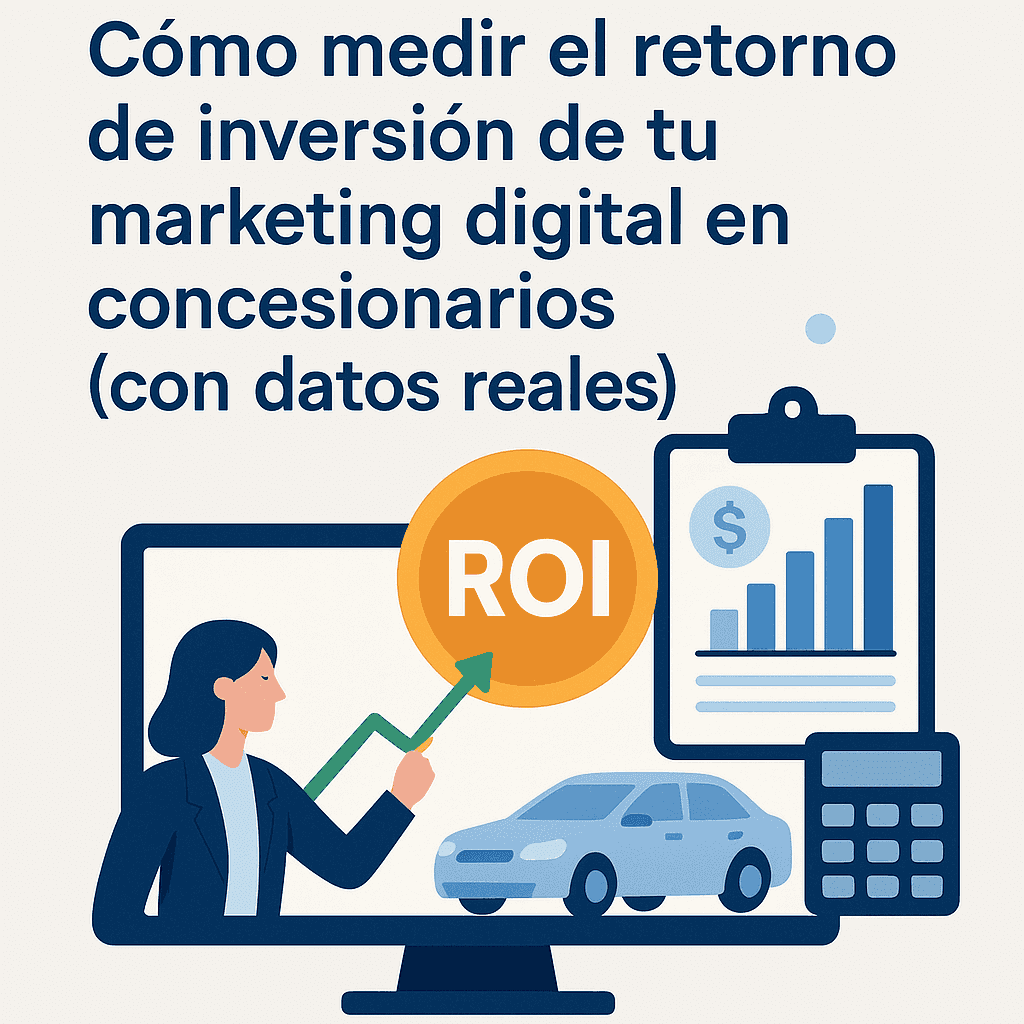
Measuring return on investment (ROI) is not optional; it is what separates a modern, profitable dealership from one that runs on inertia. It lets you know which channels work, which don’t, and how to allocate your budget better.
What exactly is ROI in digital marketing?
ROI is a simple formula with a huge impact:
ROI = (Profit obtained - Investment) / Investment
For example: if you invested 1,000 € in a campaign and generated 5,000 € in real profit, your ROI is 400%.
But… what if another channel gave you only 2 sales for the same amount? Which one is better?
The key is to track each lead back to its source and associate it with an actual sale. And that can only be done if you have a system (CRM, DMS or software like Dealcar) that centralises the data.
The most common traffic sources… and the most profitable ones?
Not all channels work the same for every dealership. That’s why it’s worth analysing them one by one:
Google Vehicle Listing Ads (VLA)
VLA is one of the most powerful tools around at the moment. Google lets you display your vehicles directly in search results, with photos, price and a call to action.
Advantages:
Quality traffic (people already looking to buy)
High visibility
You can integrate it with your inventory
How to measure it:
Tag links with UTM parameters
Connect your campaign to Google Analytics and your CRM
Compare clicks, leads and sales
Portals like coches.net, AutoScout24 and Wallapop
The classics. They’re still important, but they can be expensive if they’re not managed properly.
What you should measure:
Cost per lead (CPL)
Conversion rate (leads that end in sales)
Average time from contact to purchase
Average order value (what type of car sells best on each portal?)
Many dealerships invest more out of habit than for results. Measuring helps you cut what isn’t paying off.
Your dealership’s website
Few things are more profitable than capturing your own leads without paying per click.
Your website can be your silent conversion machine if it is well optimised:
Well-executed local SEO (“car dealership in [your city]”)
Simple, visible forms
Effective calls to action
WhatsApp or live chat for quick queries
How do you measure it? Google Analytics + CRM + form source tags.
Tracking and analysis: the heart of true ROI
Imagine this: you receive 30 leads. How many came from Google? How many from Wallapop? How many bought from you?
If you don’t know, you can’t decide.
That’s why you need tools that allow you to:
Tag the source of each lead
Link leads with actual sales
Compare results by channel
Using a CRM connected to your inventory (like Dealcar) lets you see everything in a visual, centralised way.
Decisions based on data, not gut feeling
How many times have you heard "Wallapop no longer pays off", or "Instagram brings loads of enquiries but nobody buys"?
The only way to know is by looking at the data:
How much did you invest in each channel?
How many leads came in?
How many sales did you close?
What was the margin on each deal?
With that, you can reallocate the monthly budget and focus only on what works. What doesn’t deliver results gets cut. And what does work gets boosted.
Key KPIs you should review every month
Monthly investment per channel
Cost per lead (CPL)
Conversion rate for each channel: how many leads turn into customers
Cost per closed sale
Average value per deal
Average time from contact to closing
Measuring this gives you clarity. And clarity = smart decisions.
Conclusion: it’s not about selling more, it’s about selling better
In a market where every click costs, it’s not about being everywhere. It’s about knowing where you are actually selling.
Measuring your ROI systematically allows you to:
Identify inefficient channels
Boost what does convert
Justify budgets and decisions to your team or partners
And, above all, increase your profitability
Want to see how to centralise all this data on a single platform?
Visit www.dealcar.io and discover how to measure, optimise and grow with real data.
Frequently asked questions (FAQ)
What ROI should a dealership aim for?
A healthy ROI is around 300-400%. It will depend on the type of car, margin and channel.
How do I measure whether a sale comes from a specific channel?
Use UTM tags in your campaigns and a CRM that records the lead source all the way to the sale.
Is Google VLA better than coches.net?
There is no single answer. You’ll know when you compare your own data.
What if I only have a few leads per month?
All the more reason to measure. With low volume, every lead matters more.
Can my dealership website bring in leads without paying per click?
Yes, if it is optimised for local SEO and has effective forms.
Why should you measure the ROI of your digital marketing?
Imagine that each month you set aside 2,000 € for different marketing actions: Google ads, social media posts, campaigns on portals like coches.net or AutoScout… But you’re not entirely clear which channel generates the most real sales.
That’s like throwing banknotes into the air and hoping one lands in a customer’s pocket.
Measuring return on investment (ROI) is not optional; it is what separates a modern, profitable dealership from one that runs on inertia. It lets you know which channels work, which don’t, and how to allocate your budget better.
What exactly is ROI in digital marketing?
ROI is a simple formula with a huge impact:
ROI = (Profit obtained - Investment) / Investment
For example: if you invested 1,000 € in a campaign and generated 5,000 € in real profit, your ROI is 400%.
But… what if another channel gave you only 2 sales for the same amount? Which one is better?
The key is to track each lead back to its source and associate it with an actual sale. And that can only be done if you have a system (CRM, DMS or software like Dealcar) that centralises the data.
The most common traffic sources… and the most profitable ones?
Not all channels work the same for every dealership. That’s why it’s worth analysing them one by one:
Google Vehicle Listing Ads (VLA)
VLA is one of the most powerful tools around at the moment. Google lets you display your vehicles directly in search results, with photos, price and a call to action.
Advantages:
Quality traffic (people already looking to buy)
High visibility
You can integrate it with your inventory
How to measure it:
Tag links with UTM parameters
Connect your campaign to Google Analytics and your CRM
Compare clicks, leads and sales
Portals like coches.net, AutoScout24 and Wallapop
The classics. They’re still important, but they can be expensive if they’re not managed properly.
What you should measure:
Cost per lead (CPL)
Conversion rate (leads that end in sales)
Average time from contact to purchase
Average order value (what type of car sells best on each portal?)
Many dealerships invest more out of habit than for results. Measuring helps you cut what isn’t paying off.
Your dealership’s website
Few things are more profitable than capturing your own leads without paying per click.
Your website can be your silent conversion machine if it is well optimised:
Well-executed local SEO (“car dealership in [your city]”)
Simple, visible forms
Effective calls to action
WhatsApp or live chat for quick queries
How do you measure it? Google Analytics + CRM + form source tags.
Tracking and analysis: the heart of true ROI
Imagine this: you receive 30 leads. How many came from Google? How many from Wallapop? How many bought from you?
If you don’t know, you can’t decide.
That’s why you need tools that allow you to:
Tag the source of each lead
Link leads with actual sales
Compare results by channel
Using a CRM connected to your inventory (like Dealcar) lets you see everything in a visual, centralised way.
Decisions based on data, not gut feeling
How many times have you heard "Wallapop no longer pays off", or "Instagram brings loads of enquiries but nobody buys"?
The only way to know is by looking at the data:
How much did you invest in each channel?
How many leads came in?
How many sales did you close?
What was the margin on each deal?
With that, you can reallocate the monthly budget and focus only on what works. What doesn’t deliver results gets cut. And what does work gets boosted.
Key KPIs you should review every month
Monthly investment per channel
Cost per lead (CPL)
Conversion rate for each channel: how many leads turn into customers
Cost per closed sale
Average value per deal
Average time from contact to closing
Measuring this gives you clarity. And clarity = smart decisions.
Conclusion: it’s not about selling more, it’s about selling better
In a market where every click costs, it’s not about being everywhere. It’s about knowing where you are actually selling.
Measuring your ROI systematically allows you to:
Identify inefficient channels
Boost what does convert
Justify budgets and decisions to your team or partners
And, above all, increase your profitability
Want to see how to centralise all this data on a single platform?
Visit www.dealcar.io and discover how to measure, optimise and grow with real data.
Frequently asked questions (FAQ)
What ROI should a dealership aim for?
A healthy ROI is around 300-400%. It will depend on the type of car, margin and channel.
How do I measure whether a sale comes from a specific channel?
Use UTM tags in your campaigns and a CRM that records the lead source all the way to the sale.
Is Google VLA better than coches.net?
There is no single answer. You’ll know when you compare your own data.
What if I only have a few leads per month?
All the more reason to measure. With low volume, every lead matters more.
Can my dealership website bring in leads without paying per click?
Yes, if it is optimised for local SEO and has effective forms.